What to Know Before You Visit
Find answers about visiting and shopping at our food pantry, current pantry policies, how we manage and distribute food, the statistics we report, and questions or concerns raised by community members.
When is the pantry open to the public?
Wednesdays from 5:00 pm to 8:00 pm and Saturdays from 9:30 am to 12:00 pm
Do I need to schedule an appointment to shop at the pantry?
We encourage scheduling appointment to shop at the pantry. We are in a mixed-use area that includes multiple businesses and homes and relying on scheduled visits helps us ensure that we do not have people standing in line outside for extended periods and minimizes the disturbances of residents.
A limited number of walk-ins are accepted each hour.
How do I schedule a shopping time?
You can schedule your shopping time here.
Where can I park?
- On street parking on E. Main Street is metered.
- On street parking is free after 6pm and on Sundays
- Free on street parking is available South of Juniper Lane on S. Cedar Street.
- Free off-street parking is available on North Water Street
- Accessible parking is available in the lot behind our building
- Two of the spots are reserved for people with handicap placards or plates
- We ask that the lot be reserved for those who have mobility challenges
- The lot can be accessed via one-way streets; Church Ave to Juniper Lane
We are conveniently located along a bus route with a stop on E. Main St. More details on parking can be found here.
Why have we chosen to begin sharing pantry statistics?
The answer is that, until recently, the information needed to produce meaningful and reliable reports was not readily available.
When the current leadership team assumed responsibility for the pantry, the records necessary to produce meaningful analysis either did not exist, were incomplete, or were not maintained in a format that could be readily reviewed and analyzed. While some information was available through the Central Pennsylvania Food Bank, that system is designed primarily to collect reporting from member pantries rather than provide detailed analytical tools. As a result, there is no comprehensive dashboard that allows pantry leadership to easily review trends, analyze historical performance, export reports, or generate detailed operational summaries.
Much of the available information existed only in the form of individual PDF invoices and donation records. To create an accurate picture of pantry operations, these records had to be requested, downloaded, reviewed, and manually entered into LCCL databases for organization and analysis.
During the first quarter of 2026, our focus was on stabilizing pantry operations by implementing and refining policies and procedures, documenting critical processes, and creating the operational framework necessary to ensure consistency and accountability. Once those systems were in place, we began the labor-intensive process of reconstructing historical records that should have been maintained from day one of our pantry’s operations.
We have now reached a point where we can begin reporting on pantry operations using reliable data.
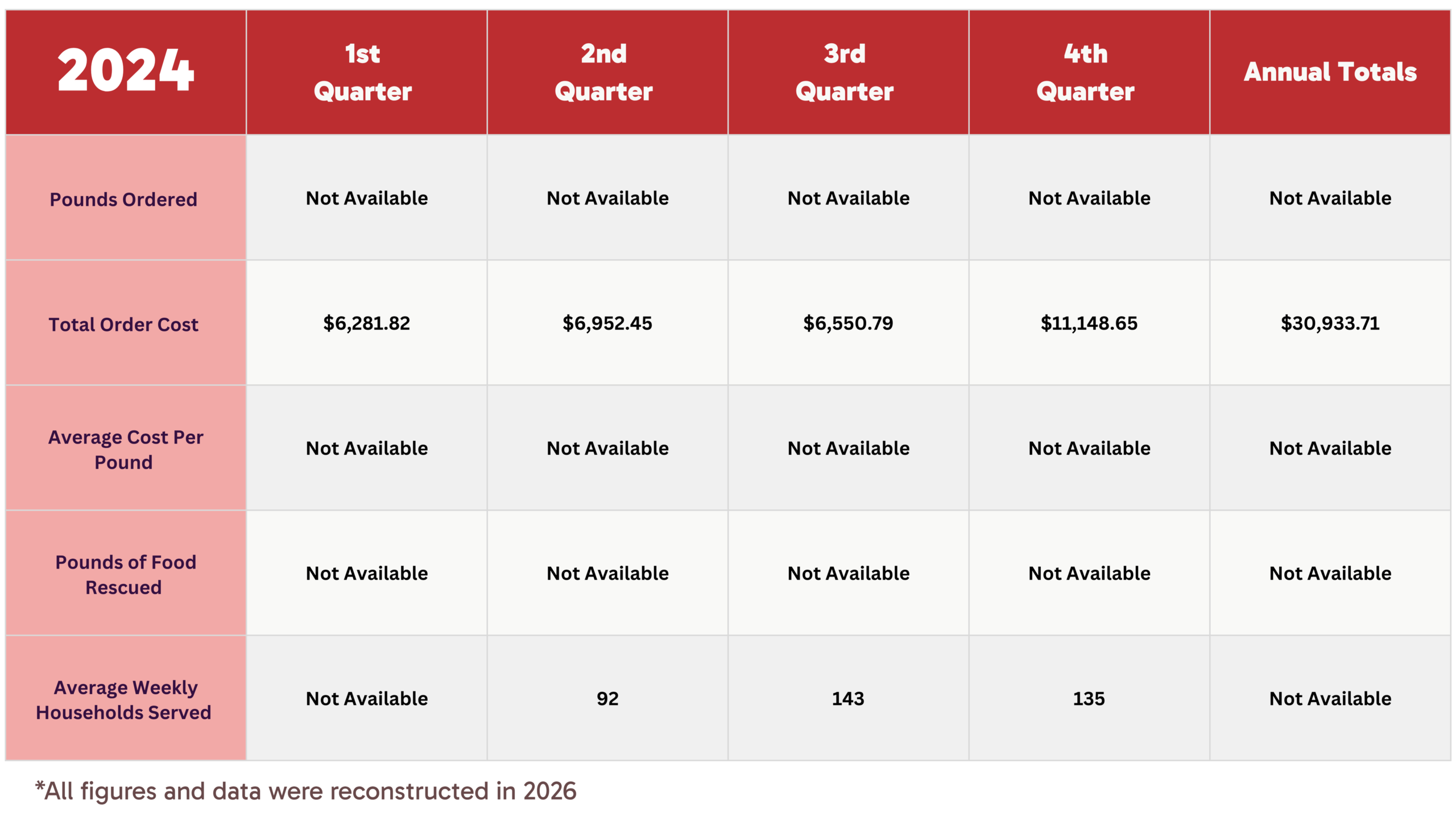
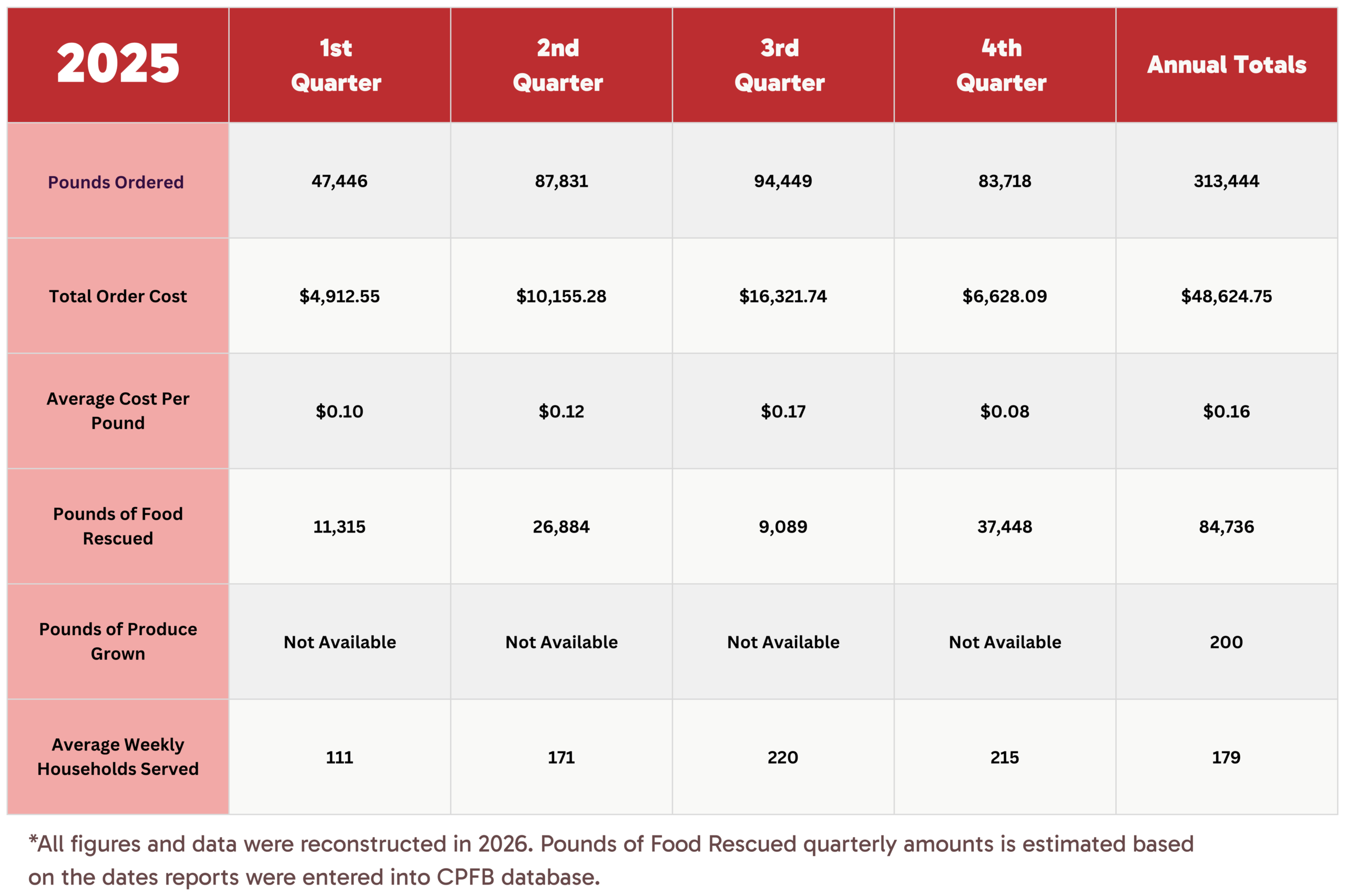
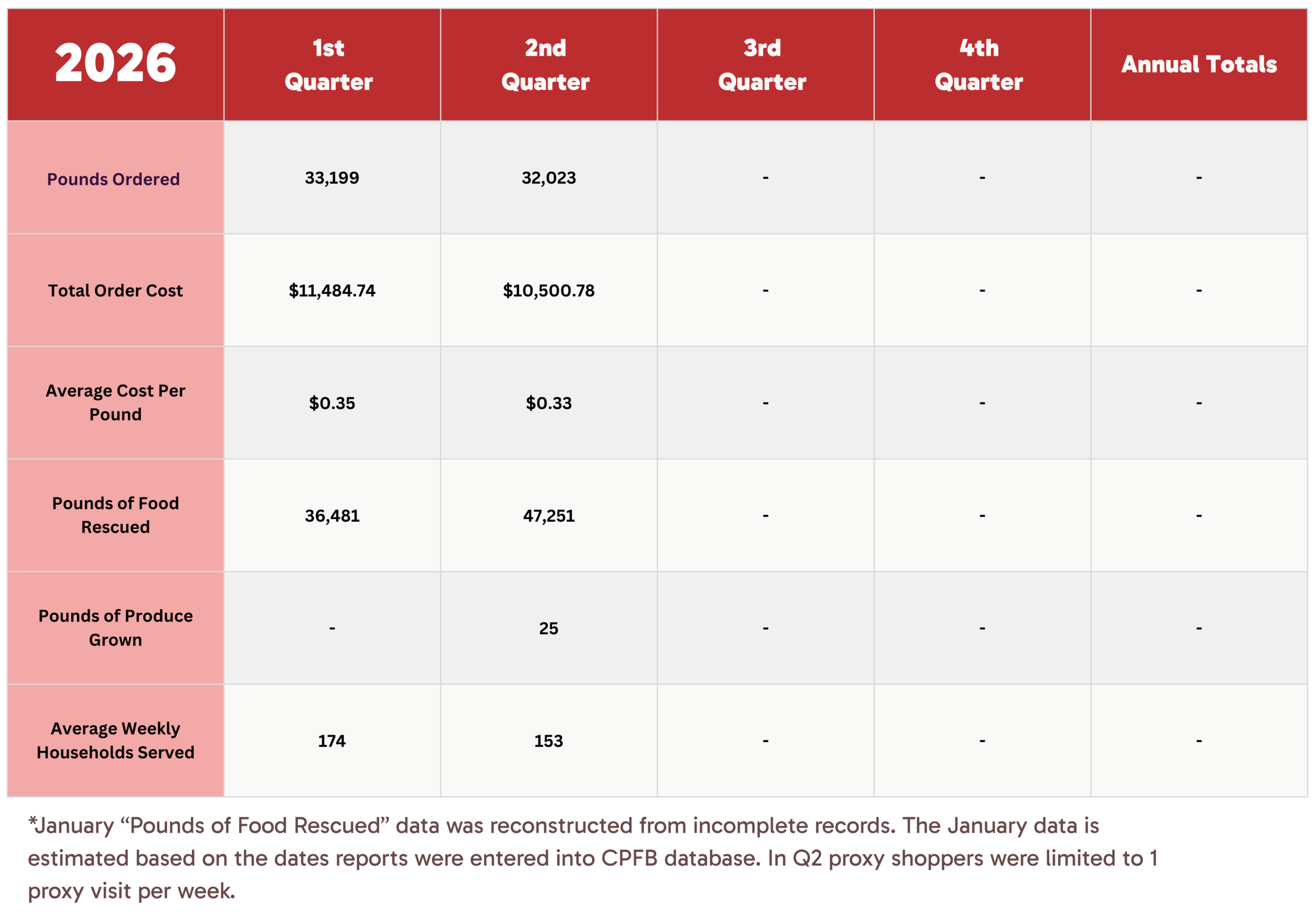
View our Pantry Statistics here:
What does Pounds of Food Rescued mean?
The Central Pennsylvania Food Bank works with retailers to rescue foods that can no longer be sold but is within the period of time when it is still safe to eat. When people talk about store donations, they are referring to the food donated to pantries through this program.
We have chosen to use the food rescued terminology so that we will have the ability to begin tracking individual and food drive donations in the future while maintaining full transparency on foods donated by stores participating in the food rescue program.
What is the difference between households served and people/individuals served and why are you reporting households only?
Households served reflects the number of family units of any size that use our pantry whereas people/individuals served reflects the total number of individuals the food distributed feeds. The total number of people/individuals served includes all family members in a household.
We have chosen to report households served because it offers a clearer picture of how many people physically visit our pantry and because the information about individuals served is broken out by demographics making it more difficult to share in a useful way.
What do you mean by reconstructed data?
Prior to February of 2026, there were no policies or practices governing the creation and maintenance of records at the pantry. As we changed pantry leadership, we discovered that invoices for purchased food were not maintained onsite. We also discovered that the records of donation pounds and temperatures were handwritten on paper with some records containing multiple stores or dates. These records were being kept at home by a volunteer and when they brought in, we discovered that many were missing. This information was entered into the Central Pennsylvania Food Bank system.
We requested, reviewed, and reconstituted the records from that period to the best of our ability.
The Rescued Food records available from the Central Pennsylvania Food Bank are individual PDF files that do not record the donor store or the date of donation. Instead, the records are offered by the date entered into the Central Pennsylvania Food Bank database. For example, in June of 2025 34 donation records were entered across 14 different days, while no records were entered in August, and a single day in November has 43 donation records.
Information about purchased food is the most accurate as the invoices provided by the Central Pennsylvania Food Bank is highly detailed.
Do you allow people to shop for someone other than their own household?
Yes. This is called proxy shopping. We limit individual proxy shoppers to 1 family at a time. If a proxy shopper also shops for themselves, they will be permitted to shop for both themselves and the proxy family.
Social workers may be permitted to shop for multiple individuals.
Beginning in the 2nd half of 2026 we will begin to require that proxy shoppers complete proxy shopper forms that must be signed by the recipient. This is a practice encouraged by the Central Pennsylvania Food Bank to ensure that the food is being delivered to the intended recipient.
The contact information provided will be validated and periodic check-ins with the receiving individual will be conducted.
Does the food pantry carry vegetarian, vegan, or gluten free items?
When possible. These items are not always available through the Central Pennsylvania Food Bank or the Food Rescue program.
Have you increased or added restrictions?
Yes. The introduction of restrictions throughout the pantry is intentional and necessary.
Previously, there were very few limits on what individuals could take. While that created flexibility, it also created inequity. Some shoppers were able to take large quantities, which meant others, especially those arriving later, or shopping on Saturday went without access to those items.
With food costs up 118.75% and total purchasing volume down 56%, unrestricted distribution is no longer sustainable. The current approach places reasonable limits on certain items so that more households can access them over the course of the week.
Reasonable limits ensure:
- More households can be served
- Food is distributed more equitably
- Key items (milk, eggs, meat, pantry staples, etc.) remain available across all service days
Durning the 2nd half of 2026 we are trialling family size-based restrictions rather than a one size fits all approach on certain items to better accommodate larger families.
Has the food pantry missed Central Pennsylvania Food Bank orders?
Yes. In 2025 and 2026 we missed the same two order windows in January. This was a result of our teams being unaware that order dates were shifted to an earlier date due to holiday closures at the Central Pennsylvania Food Bank. The 2026 misses could have been avoided if the policies, processes, and institutional knowledge had been recorded by the 2025 team as requested.
LCCL also closes the pantry for holidays, downtown Lititz street events, and planned breaks. Some orders are intentionally skipped when these closures occur on our delivery date or when an order is not required as a result of pantry closures.
Are you serving fewer people than you used to?
Our weekly average is:
- 2025: 176 households
- 2026: 165 households
Over the last few months, the number of households served has followed a gradual shift rather than a sudden drop. In late 2025, the pantry experienced a significant spike in demand, driven in part by external factors like disruptions to SNAP benefits. That period represented an unusually high peak, not a stable baseline.
Since then, what we’ve seen is a steady return from that peak toward the pantry’s historic averages.
In 2025, the weekly average was 176 households. In Q1 of 2026, the average was 174. As the return to historic averages continued, it appeared to many with a more time-limited view of the pantry that we were serving fewer people.
In Q2 we made two changes to pantry distribution. First, we began to limit Proxy shopping to a single additional household. And in Q3 we will begin requiring that Proxy shoppers complete the Central Pennsylvania Food Bank proxy shopping form in order to continue proxy shopping. Second, we ended dedicated hours for low sensory shopping and now require that people schedule in advance to shop when we have someone at the resource center to assist them. These changes have led to a small decline in the number of shoppers served each week. And our current average of 165 households served each week reflects this.
Based on historic and current data and operational capacity as well as the strain on neighbor relations, we’ve determined that the pantry can sustainably serve between 140 and 200 households per week.
So, while the numbers may look different compared to last year’s peak moments, they are in line with a stable, sustainable level of service, and that stability is intentional.
Has the pantry budget decreased in 2026?
No. the pantry’s overall funding has remained stable. What has changed, significantly, is what that money can buy.
Food costs have risen sharply, more than doubling on average. That means even though we are spending a similar number of dollars, those do not dollars stretch as far as they did before. The result is fewer total pounds of purchased food coming through the pantry, even while financial commitment remains consistent.
Is your pantry receiving fewer donations in 2026?
No. Community support through donations continues to be strong and steady. The donated pounds (Pounds of Food Rescued) through the first half of 2026 is just 1004 lbs short of the total pounds rescued in 2025. The pantry receives food five days a week from multiple retail partners; Giant stores, two Target stores, Walmart, Weis Grocery Stores, and Sheetz. Some individual donation deliveries bring in over 1,000 pounds at a time. That level of ongoing contribution plays an important role in keeping the pantry stocked and operational.
How has LCCL changed or improved its management of the food pantry?
To fully understand these changes, though, it’s important to look beyond individual concerns and consider how the pantry operated in the past.
Throughout 2025, the pantry leadership relied on informal knowledge and individual discretion. Processes were unwritten, expectations were not always clearly defined, and decisions depended heavily on who was present at a given time. In practice, this meant the pantry often functioned “by the seat of its pants.” While that approach worked in some moments, it also led to inconsistency, confusion, and inequity.
Missed orders, uneven distribution, and significant budget overruns in 2025 were all symptoms of a system that lacked clear structure. Efforts were made to have the 2025 pantry leadership document and standardize processes, but those efforts were ignored, and the challenges continued to grow.
The changes implemented over the past few months were a direct response to those conditions.
Today, the pantry operates with clearly defined rules and processes designed to create consistency and fairness. Inventory is tracked so that ordering decisions are based on actual need rather than guesswork. A just-in-time model ensures that food moves quickly into the community rather than sitting in storage for extended periods. Roles are clearly defined, and responsibilities are structured so that volunteers know what is expected, and operations run smoothly.
Underlying all of this is a commitment to four basic principles:
- Rules exist to protect both people and resources.
- Processes ensure tasks are completed consistently and correctly.
- Communication creates transparency and shared understanding.
- Defined levels of Authority ensure decisions are made by those with the full scope of information and responsibility.
In the past, the pantry’s day-to-day work relied on individual knowledge, people knowing what to do because they had done it before, rather than because it was written down or consistently taught. While that worked at times, it also meant that processes varied from shift to shift, important steps could be missed, and there was no shared standard to ensure consistency or accountability.
Today, the pantry operates from a fully documented operations handbook. This isn’t just a reference document; it’s the foundation for how the pantry runs. It clearly defines how food is ordered, how inventory is managed, how distributions are conducted, and what is expected of volunteers in each role. The goal is simple: no matter who is present on a given day, the pantry operates the same way, with the same standards.
That consistency appears in our ordering through the use of inventory tracking. Rather than relying on gut feelings or habit, we now categorize what is actually on hand as low, average, or high across food categories and use that information to guide purchasing decisions. This allows us to focus resources on items that are truly running low and a reduction in the over-ordering of items that are already well stocked.
Alongside this, we’ve shifted to a just-in-time inventory model. Instead of bringing in large quantities of food that may sit for weeks or months, we order and receive what is needed to support the current week and sometimes slightly beyond. This approach ensures that food moves quickly out into the community where it can be used, rather than being held in storage, potentially losing its quality and freshness.
Leadership has also been restructured to create a more consistent and accountable system. Rather than relying on a small, centralized group with loosely defined responsibilities, the pantry now operates with dedicated coordinator teams focused on specific areas: donation intake, food bank deliveries, and pantry distribution. Each team is responsible for its area of operation, creating clearer ownership, better communication, and more reliable execution. This distribution of responsibilities also means that no one person must remember it all or even do it all.
Taken together, these changes create a system that is not only more efficient, but more equitable; one where decisions are informed by data and policy, responsibilities are clearly defined, and the pantry can operate consistently regardless of who is on shift.
Do people leave empty-handed because you do not have enough food on the shelves?
No. This is a misconception resulting from changes in the way we manage stock and distribution.
What has changed is not whether people receive food, but how much each household takes. In the past, it was not uncommon for some individuals to leave with very large quantities, sometimes enough to empty out key items early. That often meant that later shoppers, especially those attending Saturday distributions, had fewer options. To address this, the pantry now splits midweek deliveries so that both Wednesday and Saturday shoppers have access to the same items. While this can make shelves appear less full at any given moment, it ensures that food is available more consistently throughout the week.
We’ve also restricted the number of families that Proxy Shoppers can shop for at any given time.